
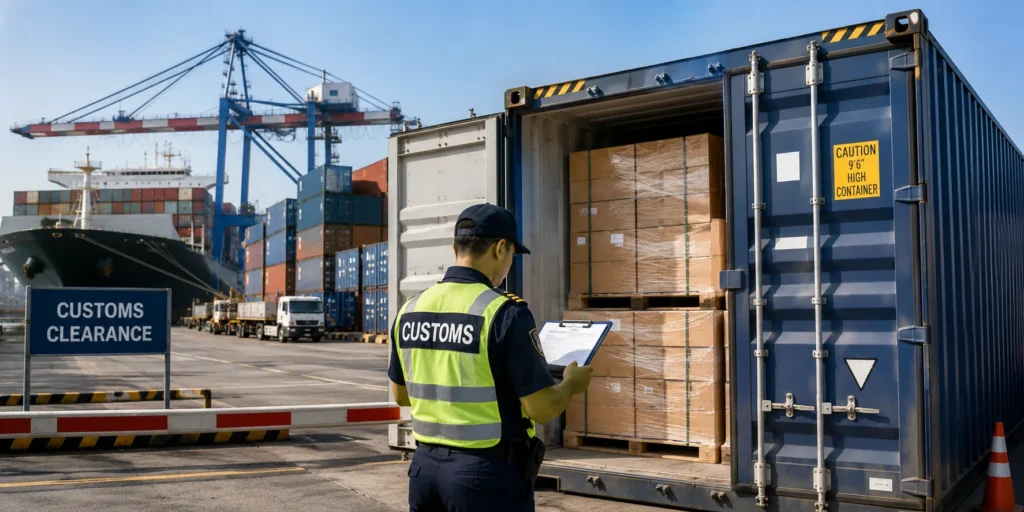
EX-A Export Declaration Netherlands
Electronic export declarations for goods leaving the European Union
EX-A Document and Export Declaration Support
Customs Services for MRN, Export Documents and Proof of Exit
An EX-A is the common commercial name for the document linked to an accepted EU export declaration. It supports the customs movement of Union goods leaving the European Union and is identified by a Movement Reference Number (MRN).
Benelux Trade Link provides customs services to prepare export data, coordinate the declaration with the shipment, follow the MRN and support the customs exit process for cargo leaving through Dutch seaports, airports and road borders.
The correct declaration depends on the exporter, goods, origin, destination, office of export, office of exit and transport route. Our customs consultancy checks the available commercial and shipment documents before the planned departure.
EX-A & MRN
Export declaration and reference coordination
Dutch Customs
Export and exit steps through the Netherlands
Carrier Alignment
Declaration data matched to the transport route
Exit Follow-Up
Support through release and exit confirmation
EX-A export declaration support includes:
- Commercial invoice and packing-list review
- Exporter and EORI data checks
- Commodity/HS code and goods-description preparation
- Customs value, origin and destination data review
- Electronic export declaration coordination
- Movement Reference Number (MRN) communication
- Office-of-export and office-of-exit coordination
- Carrier and terminal document alignment
- Exit-status and proof-of-exit follow-up
- Licence and certificate checks where applicable
- Guidance on EUR.1, A.TR and T1 where relevant
What is an EX-A export document?
“EX-A” is the term commonly used in international trade for the document associated with an accepted EU export declaration. The electronic declaration receives a Movement Reference Number (MRN). The MRN identifies the customs movement and connects the declaration to the exit process.
An EX-A is not a substitute for a commercial invoice, packing list, transport document or product-specific licence. These documents provide the data and evidence needed to prepare the declaration and move the goods through the export and exit offices.
When is an export declaration required?
Dutch Customs states that Union goods leaving the EU customs territory require an export declaration. Goods moving from the Netherlands to another EU member state do not normally require an export declaration. The correct procedure must be assessed separately for temporary export, re-export, returned goods, goods under customs supervision and controlled products.
Read the official Dutch Customs explanation of submitting an export declaration.
Information needed for an EX-A
To prepare an export declaration, we generally request:
- a commercial invoice with exporter, buyer, value, currency and Incoterms;
- a packing list with package count, gross/net weight and dimensions;
- the exporter’s EORI number and relevant party details;
- an accurate goods description and commodity/HS codes;
- country of origin and destination;
- transport booking, vehicle, container, vessel or flight details;
- the intended office of export and office of exit;
- export licences, certificates or preference/origin evidence where required.
Missing or inconsistent details can delay acceptance, carrier presentation or release. Send the information before cargo reaches the terminal whenever possible.
From declaration acceptance to customs exit
After the electronic export declaration is accepted, Customs can carry out a documentary or physical check. Once released, the goods move toward the customs office of exit. The goods are presented there and must physically leave the EU customs territory.
Dutch Customs explains that goods exiting through the Netherlands are brought to the responsible seaport or airport office, presented for inspection and included in the outward clearance process. After departure, the customs offices confirm that the goods have exited. See the official explanation of how customs exit works.
MRN and proof of exit
The MRN is the unique reference used to follow the export movement. Completion of the exit process is important because the exporter may need evidence that the goods left the EU, including for VAT records and audit purposes. We help align the declaration, carrier reference and exit information and follow up when the expected status is missing.
EX-A for sea, air and road exports
We coordinate EX-A export declarations with sea freight from Rotterdam and other Dutch ports, air freight through Amsterdam Schiphol and road transport to non-EU destinations or exit points. If goods first move under customs transit, the export and transit sequence must be planned together.
EX-A, EUR.1, A.TR and T1: which document does what?
An EX-A document relates to the export declaration and EU exit process described above. A EUR.1 certificate is separate proof of preferential origin and may support reduced or zero duty only under an applicable trade agreement when the product rules and origin conditions are met. An A.TR certificate confirms the free-circulation status of qualifying goods under the EU–Türkiye customs union; it is not proof of origin. A T1 transit document allows non-Union goods to move under customs supervision before final clearance and does not replace an export declaration.
Depending on the goods and destination, other export documents may include a Certificate of Origin, EUR-MED, REX or invoice origin statement, ATA Carnet, export licence, veterinary or phytosanitary certificate, or legalised commercial document. Our customs clearance and customs services team helps identify the likely document set and can connect the process to warehousing, but does not replace the competent issuing authority.
Need an EX-A from the Netherlands? Request customs assistance, request a quotation or contact our team with the invoice, packing list, EORI, goods description, commodity code, destination and transport booking.
Customs services frequently asked questions
What is an EX-A export declaration?
EX-A is the common trade term for the document associated with an accepted EU export declaration for goods leaving the EU customs territory. The declaration receives an MRN.
When do I need an EX-A from the Netherlands?
Union goods exported from the Netherlands to a destination outside the EU normally require an export declaration. Movements to another EU member state generally do not.
Which documents are required for an EX-A?
The usual starting documents are a commercial invoice, packing list, EORI details, goods description, commodity codes, origin, destination, Incoterms and transport booking. Additional licences or certificates depend on the goods.
What is an MRN?
The Movement Reference Number is the unique customs reference assigned to the accepted electronic declaration and used to follow the export movement through the exit process.
What is proof of exit?
Proof or confirmation of exit indicates that the goods completed the EU customs exit process. Exporters may need this evidence for their records, including VAT and audit support.
Can you arrange the EX-A and transport together?
Yes. We coordinate the declaration data with sea, air or road transport so the carrier, terminal and customs references remain aligned.
What is the difference between EX-A and EUR.1?
EX-A relates to the EU export declaration and exit process. EUR.1 is separate evidence of preferential origin that may support reduced duty only where an applicable trade agreement and origin rules are satisfied.
Can an A.TR certificate replace an EX-A document?
No. A.TR confirms free-circulation status for qualifying EU–Türkiye trade; it is not an export declaration and is not proof of preferential origin.
Does a T1 transit document replace an export declaration?
No. T1 allows non-Union goods to move under customs supervision before final clearance. It is a transit procedure, not an export declaration or origin certificate.
Need an EX-A document for an export from the Netherlands?
Send the route and available export documents before departure for a practical declaration and exit review.
Request customs assistance